
Programmatic on CTV: As Smart as We Think?
CTV blends big-screen impact with programmatic precision – but needs transparency and context to reach its full potential.

Marketers have more data than ever before, yet less confidence in what truly works. The winners of 2026 won't measure more – they'll measure with meaning. Here's the framework that makes the difference.

There is a paradox at the heart of modern advertising.
Marketers have more data than ever before, yet less confidence about what truly works.
McKinsey report “Connecting for growth: A makeover for your marketing operating model” highlights this gap.
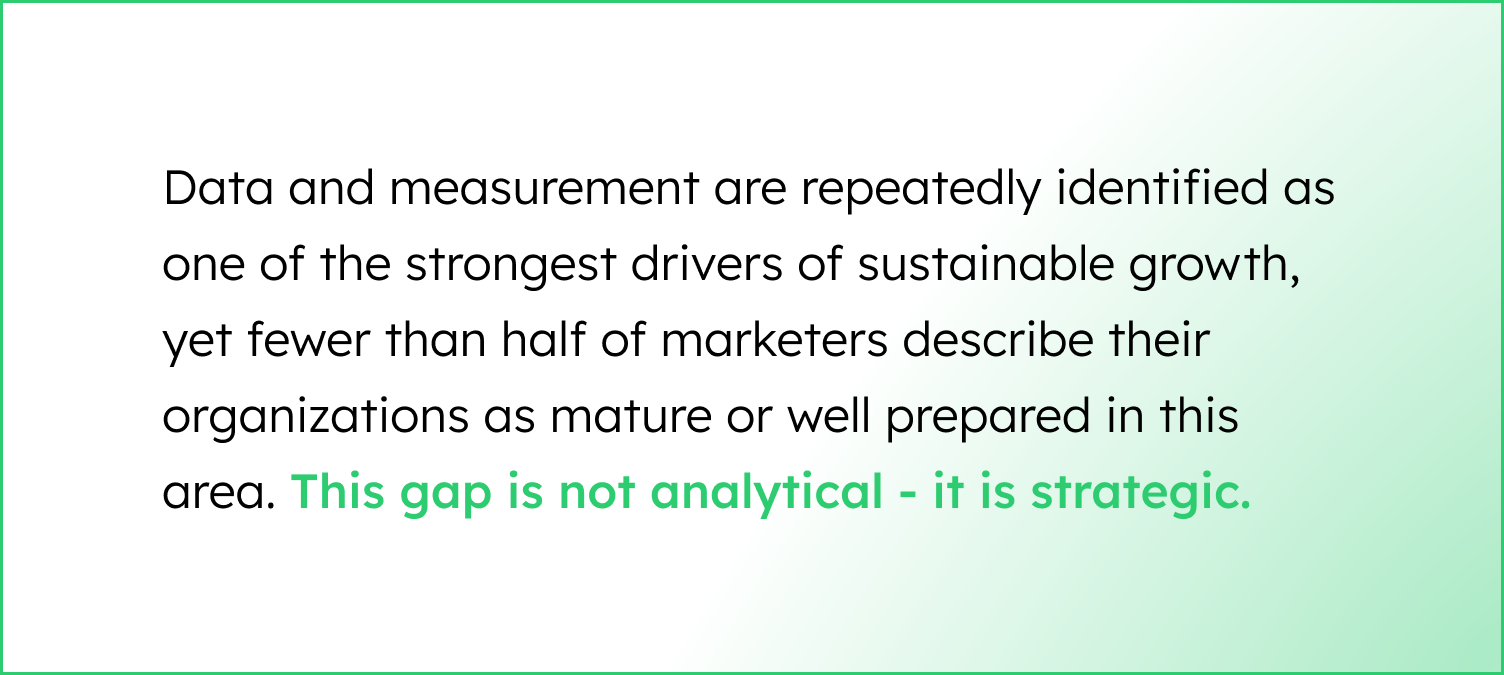
Every brand today operates inside an ecosystem of dashboards, pixels, clean rooms, attribution tools, brand trackers, and econometric models. The result is not a lack of data – but a lack of measured intelligence: connected, decision-ready insight that bridges media delivery, brand impact and business outcomes.
Fragmentation is not only technical – it is organizational, cultural and economic. Implementing everything in-house is expensive, slow, and risky. It demands scarce expertise, long adoption cycles, and high opportunity cost.
As the programmatic market moves into 2026, the competitive advantage will belong to brands that learn faster and cheaper: those that acquire the right insights, activate them quickly and deliberately choose which capabilities to build versus which to partner for. The hidden differentiator will not be access to more tools, but access to the right measurement partnerships – partners that simplify complexity instead of amplifying it.
When marketers talk about fragmentation, the instinctive response is consolidation. But consolidation without purpose only creates larger silos.
The more effective starting point is categorization by outcome. Every measurement solution – no matter how sophisticated – exists to answer one fundamental question: what business problem does this help solve?
In theory, the “holy grail” of measurement is one-to-one sales attribution. In practice, this is neither fully achievable nor strategically sufficient – especially in the open web and premium programmatic environments where brand building and long-term demand creation remain essential.
What high-performing advertisers increasingly recognize is that success in programmatic requires strong measurement fundamentals, layered deliberately from exposure quality, to brand impact, to commercial outcomes. These layers are interconnected. Weak foundations compromise everything above them.
This leads to a pragmatic and scalable framework:
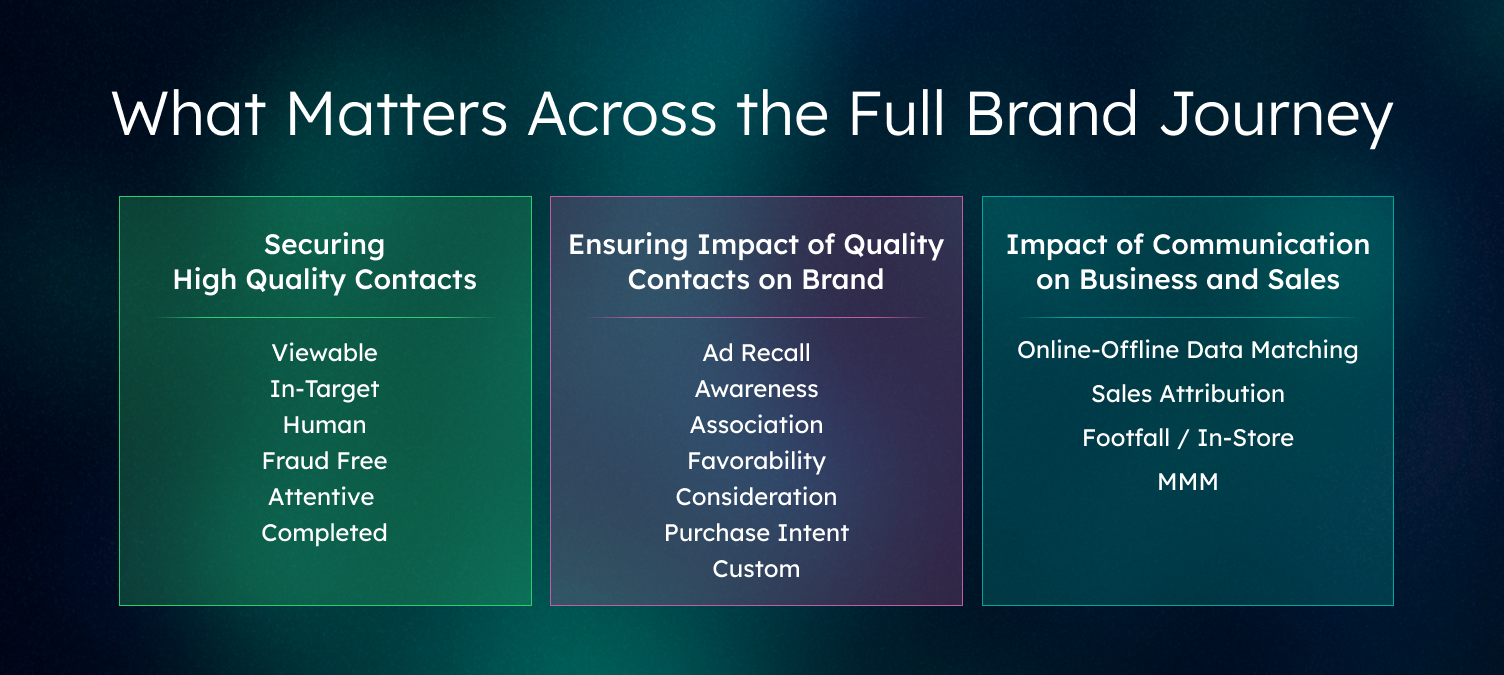
Before brand lift or sales can exist, advertising must first reach real people in meaningful environments. High-quality contacts are not a hygiene metric – they are a prerequisite for everything that follows.
Media outcome measurement focuses on confirming that advertising was delivered properly and to the right audiences. Its purpose is not optimization for its own sake, but to ensure that what follows – brand measurement and business outcomes – can be trusted. When impression quality is weak, reach is overstated, brand impact is misread and attribution becomes unreliable.
Before brand lift or sales impact can exist, advertising must first earn the right to matter. Media outcomes provide this foundation, determining whether programmatic investment creates meaningful signal or simply adds noise.
Its role is not optimization, but validation: confirming that ads were delivered to real people, in suitable environments, and under conditions that allow influence to occur. Viewability, brand safety, fraud prevention, and delivery accuracy are not “media KPIs” – they are statistical safeguards. When this foundation is weak, brand studies overstate lift and sales models misattribute impact. Independent verification partners such as IAS and DoubleVerify have become table stakes, while supply-side quality frameworks increasingly reduce waste before it ever enters the auction.
As spend shifts toward CTV, streaming, and retail media, the critical question is no longer how many impressions were served, but how many new and relevant people were reached. Deduplicated reach, in-target delivery, and overlap reduction expose whether budgets are expanding influence or merely recycling exposure. Cross-platform measurement partners like Nielsen, Kantar or AudienceProject provide the audience truth sets that prevent planners from confusing gross reach with incremental growth.
Traditional models assume that all impressions contribute equally – a simplification that no longer holds in fragmented, high-choice environments. Attention metrics correct this blind spot by introducing a quality lens that reflects how long, how deeply, and in what context ads are actually experienced. Research from Adelaide shows that when these attention signals are integrated into Marketing Mix Models, the models explain performance more accurately and deliver stronger forecasts than those relying only on impressions, viewability, or completion rates. Partners such as Adelaide and Lumen increasingly act as the bridge between media delivery and business measurement, converting raw volume into quality-adjusted, decision-ready signals.
If media outcomes establish the conditions for impact, brand outcomes confirm whether advertising actually worked. This layer moves measurement beyond exposure and into influence – testing whether communication altered perception, memory, and intent in ways that support long-term growth.
Effective brand measurement operates across three increasingly strategic depths of insight.
At the most tactical level, this layer answers a simple but essential question: was the advertising noticed, remembered, and understood? Recall and message association validate creative cut-through and signal whether communication broke through clutter. These metrics create fast feedback loops, allowing marketers to diagnose underperformance early and refine creative, formats, or contexts before inefficiency compounds.
Beyond recall, brand lift evaluates whether exposure shifted the metrics that influence choice – awareness, consideration, favorability, and purchase intent. These indicators reveal whether campaigns are shaping consumer mindset in a direction aligned with business objectives, bridging the gap between short-term exposure and future demand.
The most strategic layer focuses on long-term brand strength and competitive position. Associations, preference, first choice, image attributes, and benchmarked performance against category norms reveal whether communication is reinforcing or eroding brand meaning over time. This depth is particularly critical for premium brands and categories with longer purchase cycles, where immediate sales response underrepresents true value creation.
Brands that treat brand measurement as a soft, optional layer will systematically misallocate budget – optimizing for short-term efficiency while quietly eroding future demand. Brands that invest in rigorous, outcome-linked brand measurement gain a structural advantage: they know not only what performed, but why, for whom, and how that impact compounds over time.

Business outcomes command the most executive attention – and for good reason – but they are also the most complex to measure correctly. Feasibility is shaped by data availability, privacy constraints, market structure, and category-specific dynamics. As a result, there is no single “best” method for proving impact.
Leading advertisers therefore deploy multiple complementary measurement pathways, each illuminating a different dimension of commercial value. Real business impact is established by matching media exposure to outcomes deterministically, probabilistically, or through modeled inference.
Five practical pathways we can point in today’s landscape:
Marketing Mix Modeling occupies a singular role in the measurement ecosystem. It does not compete with attribution, brand lift, or attention metrics – it synthesizes them. Where other approaches explain what happened at specific touchpoints, MMM explains why it happened at the system level, placing media performance in the broader context of price, promotion, distribution, seasonality, and competitive dynamics.
Modern MMMs have evolved significantly from their historical, slow-moving predecessors. Built on privacy-safe, aggregate data, they are inherently resilient to signal loss, identity constraints, and regulatory change. This makes them uniquely suited to today’s fragmented, post-cookie environment. Just as importantly, advances in automation, data engineering, and modeling techniques have shortened time-to-insight, allowing MMM (Rapid MMM) to inform planning and optimization cycles rather than only post-mortem analysis.
The strategic power of MMM lies in its ability to create a common measurement currency across channels and objectives. By normalizing disparate inputs – from reach and attention to brand lift and sales signals – MMM enables true omnichannel comparability. It answers the questions executives actually care about: which investments drive incremental value, where diminishing returns begin, and how budgets should be reallocated to maximize both short and long-term impact.
In doing so, MMM elevates measurement from performance reporting to strategic governance. ROI, marginal returns, and cost per incremental outcome become decision tools rather than retrospective KPIs.
When used correctly, MMM does not simply validate past spend – it shapes future investment strategy, aligning marketing decisions with financial accountability and growth ambition.
Programmatic advertising will not be won by those who measure the most, but by those who turn measurement into intelligence.
As the industry moves toward 2026, the challenge is no longer data availability – it is coherence. Media quality without quality-adjusted exposure creates noise. Brand lift without context creates false confidence. Sales attribution without system-level understanding encourages short-term optimization at the expense of sustainable growth.
Measured intelligence emerges when these layers are connected: when media delivery, brand impact, and business outcomes are interpreted together rather than in isolation. Media outcomes establish credibility. Brand outcomes confirm influence. Business outcomes validate value. And Marketing Mix Modeling ties them into a decision-ready strategic framework.
The advertisers that outperform will not accumulate more tools or dashboards. They will build intentional measurement ecosystems, selecting partners that simplify complexity and translate signals into action.